
Reading Time: 10 minutes
Author: Factory Manufacturing Engineer
—
Introduction: Why a Surgeon Should Know How Their Scalpel is Made
If you are an ophthalmologist seeing 50 patients a day, your instrument table’s lift button is likely pressed 100 times daily. That’s 36,000 times a year. In ten years, 360,000 times.
Do you know what supports those 360,000 quiet movements?
Most people buy a table based on three numbers: tabletop size, weight capacity, and price. But what truly determines if a table remains as steady as a rock under a slit lamp for a decade, whether it avoids making a cringeworthy noise during every lift, and whether it maintains its factory shine after five years—none of these are written on product brochures.
They are hidden within the factory workshop.
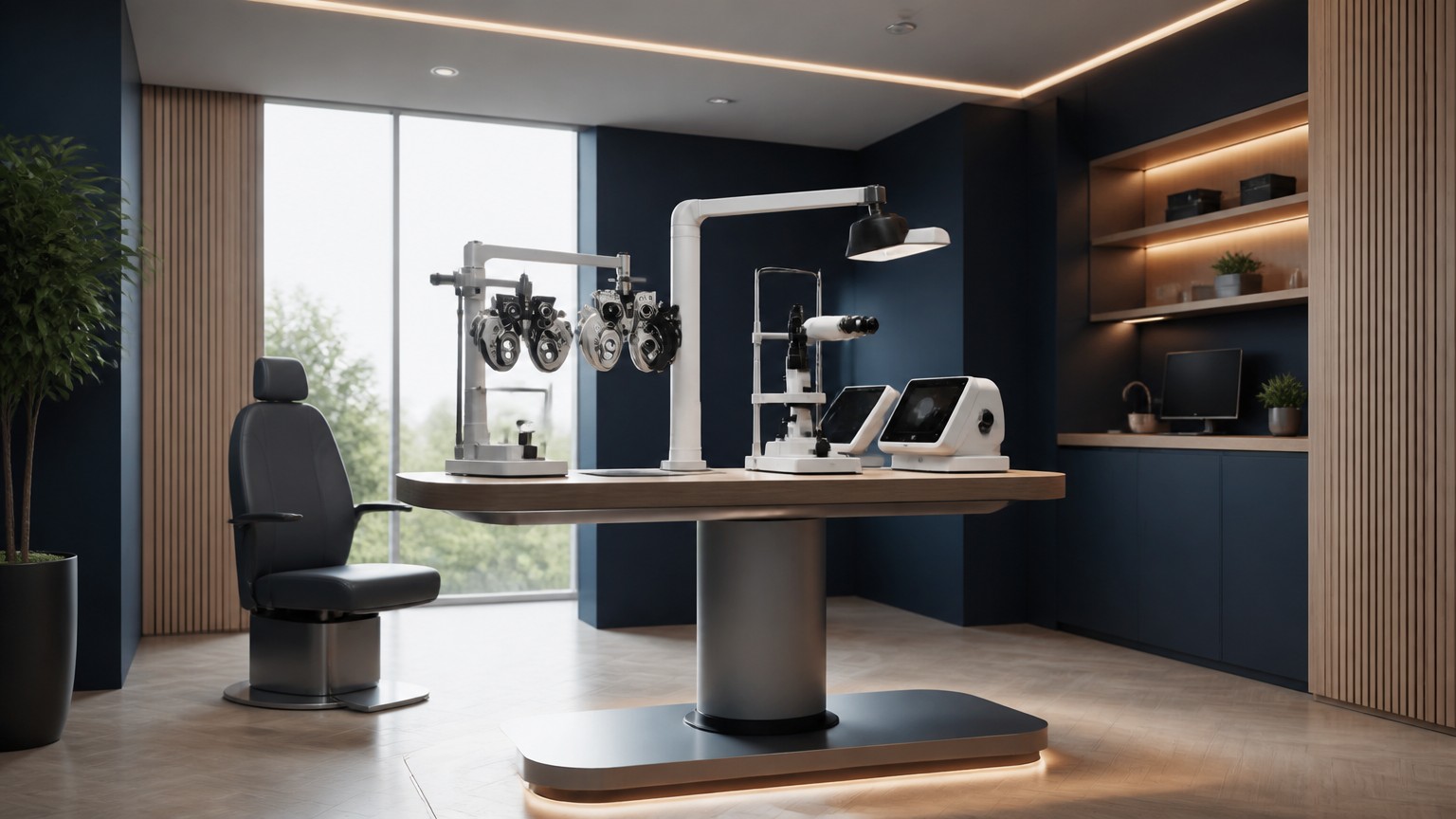
Today, we take you inside a real, operating ISO 13485 medical device production facility—6,000 square meters across two floors, 4 assembly lines, and a monthly capacity of 4,500 units—to deconstruct the process step-by-step: from a raw steel plate to a precision lifting table carrying a Topcon OCT.
—
Chapter 1: Material In-feed — A Great Table Starts with Great Steel

The Choice of Steel: Why 2mm Wall Thickness Matters
The first checkpoint in the workshop’s quality control (QC) is at the raw material warehouse.
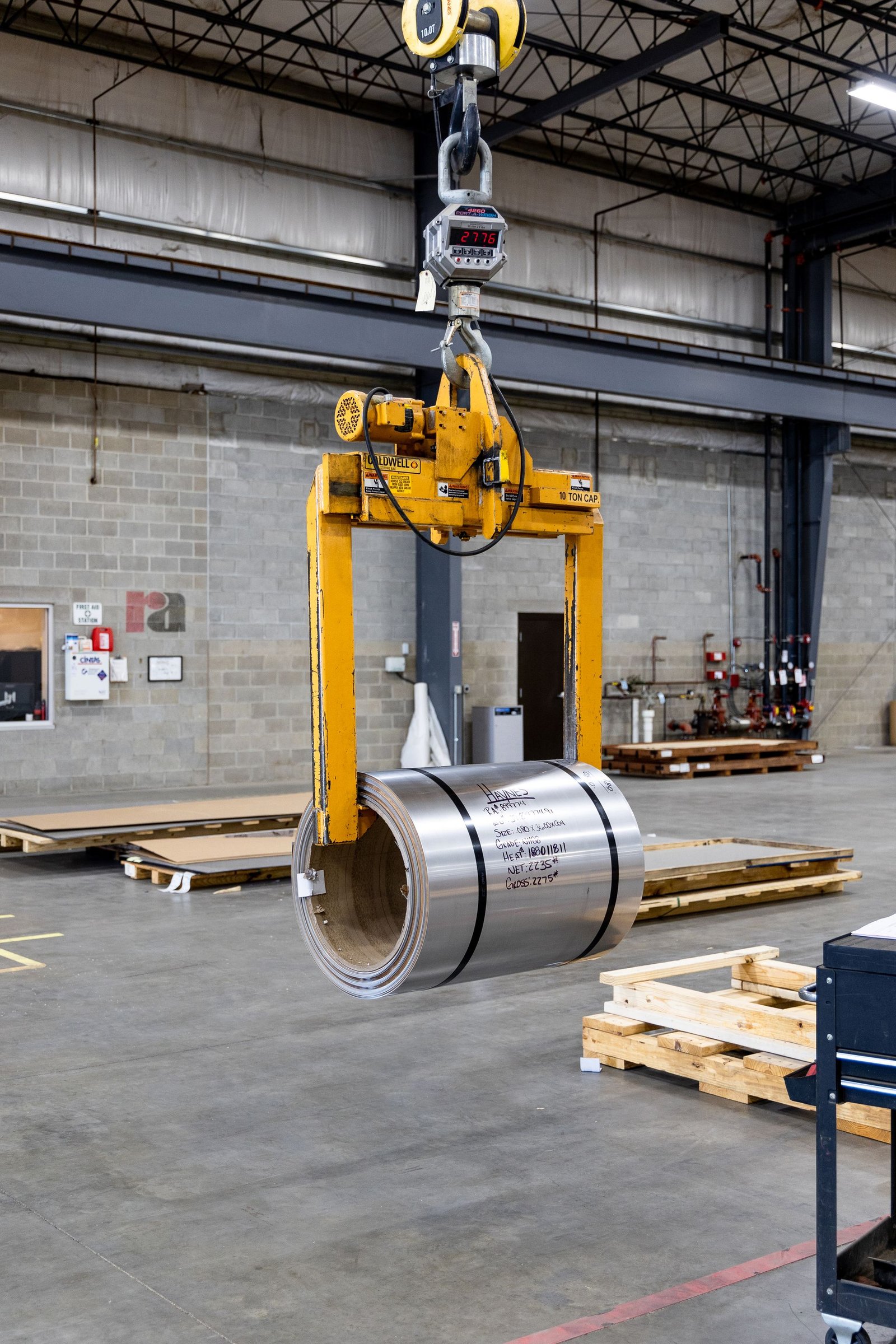
The “skeleton” of a table—the lifting columns and the base frame—is made from cold-rolled steel plates. There are three common wall thickness specifications used in the industry:
| Wall Thickness | Typical Use | Clinical Consequence |
|:—|:—|:—|
| 1.5mm | Common in low-end competitors | Columns bend slightly under load; uneven tabletop; slit lamp focus drifts. |
| 2.0mm | Hongdee Standard (Full HD-18 Series) | Zero deformation under 50kg; precise focus for tonometers/slit lamps. |
| 2.5mm | Jack Pro Columns | Maintains zero deformation even at 80kg; fits heavy equipment like Topcon OCT. |
That 0.5mm difference manifests in the clinic as follows: When you place a 15kg slit lamp on a table with 1.5mm walls and raise it to its maximum height, the bending stress on the outer column causes a microscopic, yet optically detectable, deformation. You’ll find yourself needing to turn the slit lamp’s focus knob an extra half-turn to clear the corneal endothelium—not because your hand is shaking, but because your table is “breathing.”
Factory Detail: Before any batch of steel enters the warehouse, QC inspectors randomly sample three pieces for hardness and micrometer testing. Wall thickness tolerance is strictly controlled within ±0.05mm. Anything exceeding this tolerance is rejected, as errors at this stage would be amplified by laser cutting and bending.
Pipe Sections and Surfaces
Square tubing (30×60mm) is the standard for lifting columns. However, not all 30×60 tubes are equal; they vary significantly in corner radius and straightness depending on the steel mill.
– Premium Tubing: Uniform corner radius (approx. R3), straightness deviation <1mm per meter.
– Budget Tubing: Uneven radius, visible “banana curvature” after bending.
This deviation is further magnified during welding. Two slightly curved columns welded to the same base will result in a tilted tabletop—not due to assembly error, but because of poor material choice.
—
Chapter 2: Laser Cutting — Computers Decide Every Millimeter
CNC Programming: From Blueprints to Steel
3D models created in SolidWorks must first be “unfolded” into flat part diagrams. The base plate, caster brackets, cable fixing tabs, and actuator mounts—each part is a distinct 2D contour “drawn” by a laser head onto a single sheet of steel.
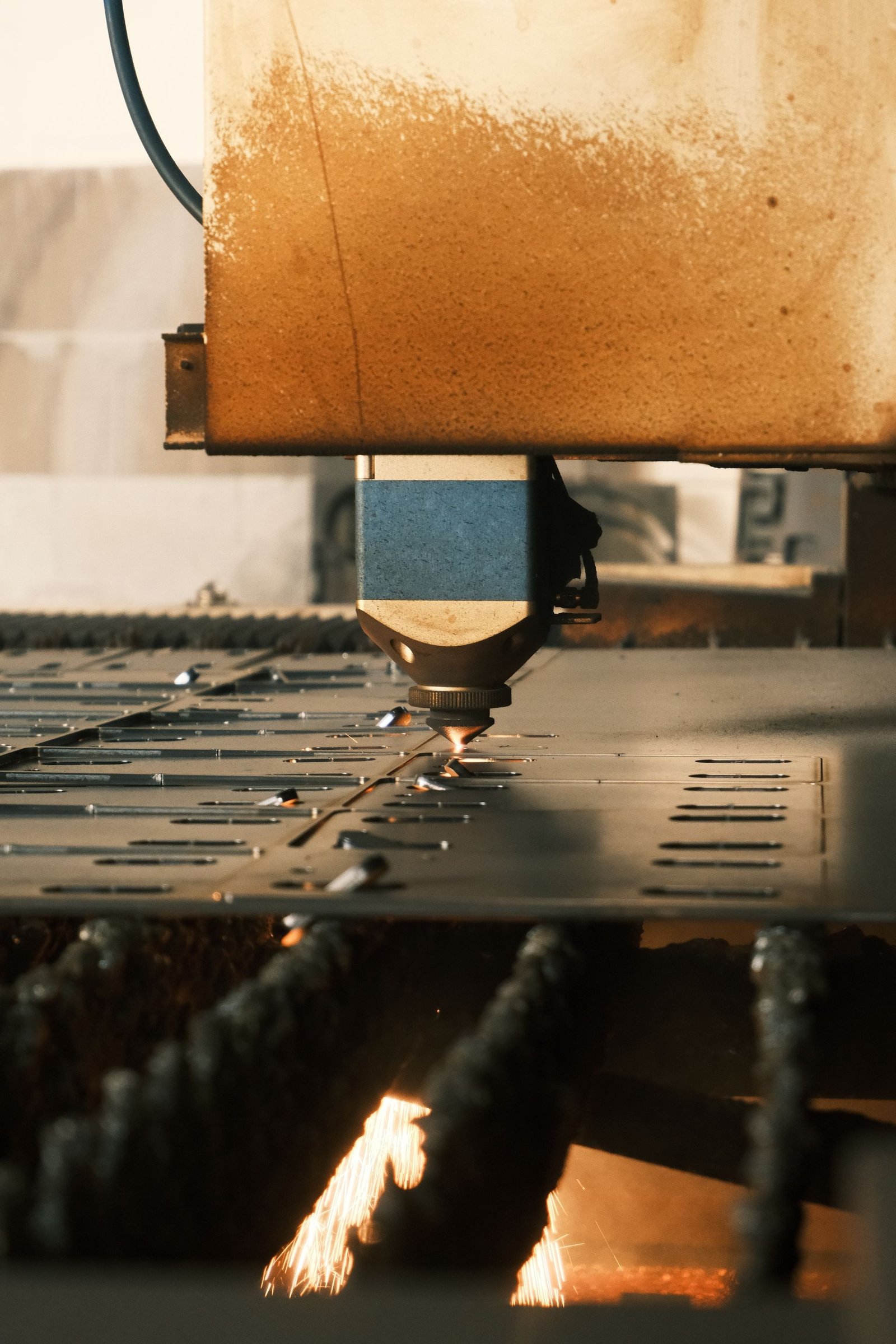
Factory Detail: The workshop utilizes high-power fiber laser cutting machines with a precision of ±0.1mm. The entire steel sheet (usually 1.5m × 3m) is secured by vacuum suction. The laser head moves at high speed following G-code paths. The kerf width is only 0.2mm. Nitrogen-assisted cutting is used to prevent the edges from oxidizing or turning black, ensuring a clean metal surface for subsequent welding and coating.
Cutting a complete set of metal parts for a standard HD-18T takes about 8–12 minutes. The nesting density determines material utilization. Good nesting can yield 15–18 sets per sheet, while poor nesting yields only 12. This is a hidden profit point for factory cost control, but for the end-user, it means: A good factory is motivated to invest the money saved on materials into more critical areas, such as better motors.
Why Laser Cutting Instead of Stamping?
Stamping is faster but requires expensive molds, costing tens of thousands of dollars, suitable only for parts produced in millions. The ophthalmic table industry produces thousands to tens of thousands of units annually, making stamping uneconomical. Furthermore, the spring-back effect in stamping can reduce the precision of hole diameters and contours.
Laser cutting has zero mold cost, and switching models only requires a code change. This is why Hongdee can offer 11+ tabletop sizes and numerous OEM customizations—flexible production is the core competitiveness in small-to-medium batch medical device manufacturing.
—
Chapter 3: CNC Bending — Turning Flat into 3D
After laser cutting, the base plates, side panels, and tabs are still flat. Next comes the CNC press brake.
Why Bending Precision Determines the Table’s “Posture”
The base plate is the foundation of the entire table. It needs to be bent with two reinforcing ribs—not just a simple right angle, but a precise “U” shape using a CNC back-gauge system for positioning.
Factory Detail: Bending angles are controlled at 90° ± 0.5°. Experienced technicians program “spring-back compensation.” Cold-rolled steel typically springs back about 1.5°–2°, so the die angle is set at 88°–88.5° to achieve a perfect 90° after release. This adjustment isn’t in any manual; it relies on the technician’s feel for the steel’s hardness.
If bending precision is insufficient, the base will warp. A warped base leads to a “three-legged” table that wobbles when raised to its highest position. It’s not a wheel issue; it’s a 3° deviation built into the base plate from the factory.
—
Chapter 4: Welding — The Invisible Art of Skeleton Building
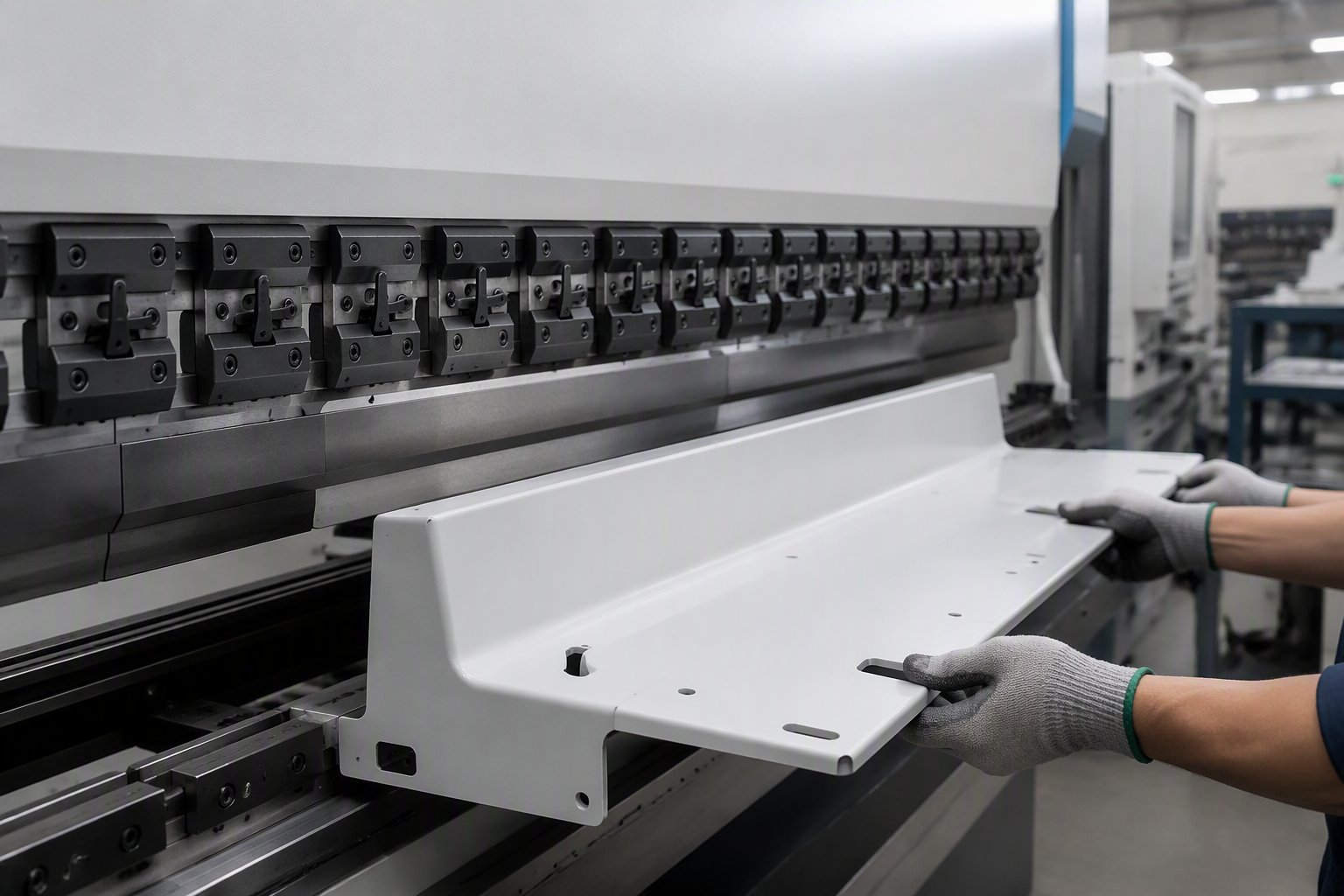
Welding is the most “human” part of the process. While machines ensure consistency, a welder’s skill determines the ultimate strength and lifespan.
CO₂ Shielded Welding vs. Manual Arc Welding
The Hongdee workshop uses CO₂ shielded welding (MIG/MAG). Why not cheaper manual arc welding? Because ophthalmic table welds have a specific requirement: surface post-processing friendliness.
– Manual Arc Welding: High slag and heavy spatter. Every weld requires hammering off the slag, which can dent the base metal. These dents form “pinholes” in the powder coating—rust eventually emerges from these holes months later.
– CO₂ Shielded Welding: Almost no slag, smooth surfaces, and minimal spatter. It goes straight to the polishing line. The CO₂ gas shields the molten pool from oxidation, resulting in higher strength and better toughness.
Critical Weld Points: Where the “Soul” Resides
A lifting table has about 15–25 welds. Three are most critical:
1. Columns to Base Plate Welds
This is the table’s “ankle.” When raised to maximum height (880mm–900mm), the entire center of gravity is elevated, maximizing the leverage force on the base. Any poor weld here will lead to cracks within five years.
Factory Detail: This area uses continuous welding (full weld), not skip welding. 0.8mm ER50-6 solid wire is used. The welder must grind off the oxidation layer before welding to prevent arc instability and internal porosity—defects that only X-rays can see, but which compromise structural integrity.
2. Caster Plate to Tubing Welds
This is the most common area for “corner-cutting.” Some competitors screw casters directly into the 1.5mm tube wall, allowing for only 2–3 threads of engagement. The torque from moving a 50kg table will eventually strip these threads.
Factory Detail (Jack Pro Level): A 5mm thick reinforcing steel plate is first welded to the tube end, then the caster is screwed into this plate. A 5mm plate allows for 8–10 threads. The torque is absorbed by the reinforcement plate, not the tube wall. Adding a small piece of iron and an extra weld adds five years to the table’s life.
3. Actuator/Motor Mount Welds
The actuator is the power source. Any vibration or counter-force during operation can cause weld fatigue.
Factory Detail: Actuator mounts use double-sided fillet welds—welded from both sides to ensure strength regardless of whether the actuator is pushing or pulling. Single-sided welds are fatal under these alternating loads; they act like a Band-Aid being slowly peeled away.
—
Chapter 5: Surface Treatment — Coating is More than “A Layer of Paint”
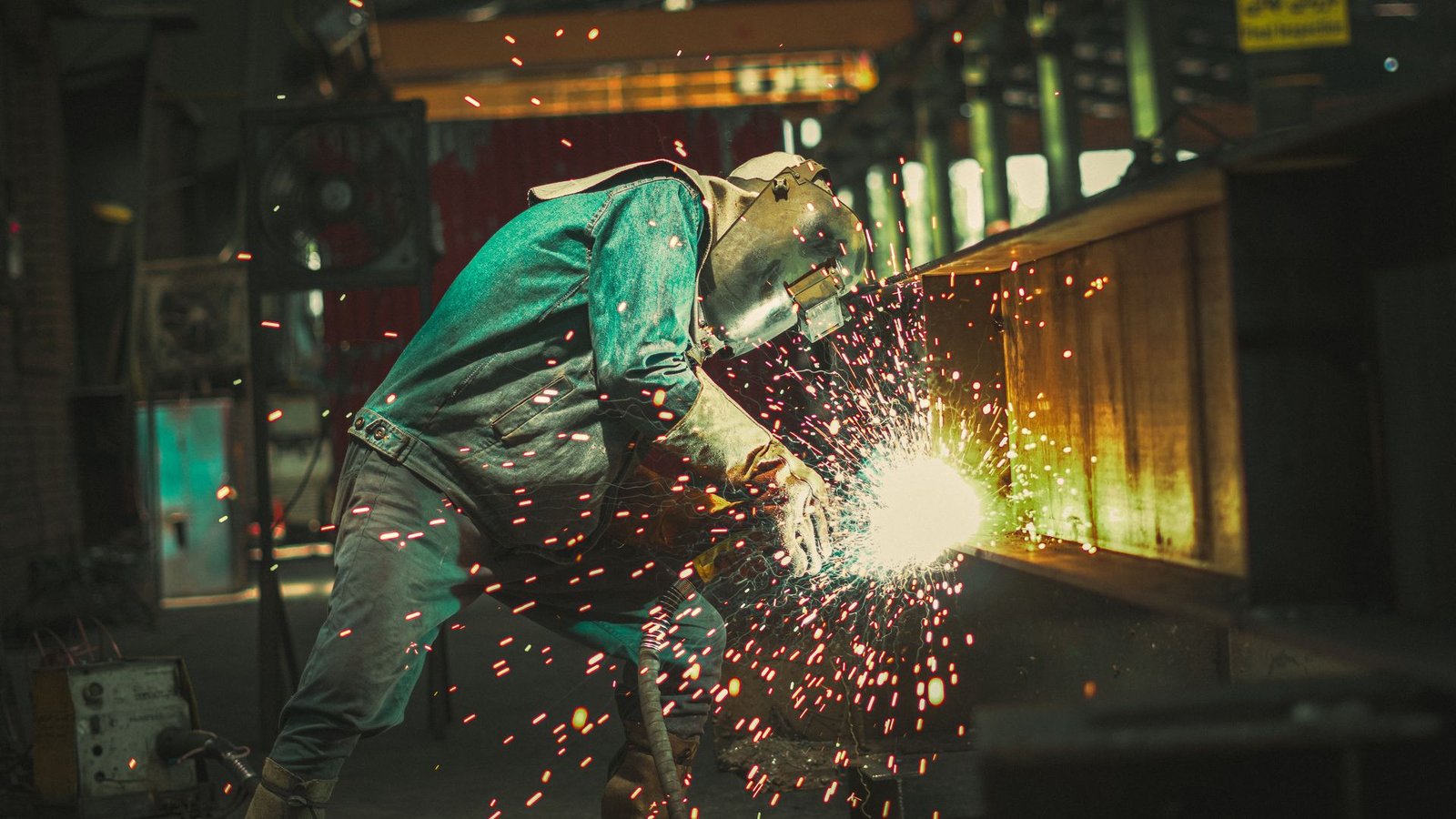
This is perhaps the most misunderstood part of manufacturing. Many believe coating just means “painting the table white.” In reality, proper coating determines how gracefully a table ages in a clinic.
Pre-treatment: Why Steel Needs a “Bath”
Before entering the coating booth, every welded part undergoes a comprehensive pre-treatment:
1. Shot Blasting: High-speed steel shot (φ0.6–0.8mm) removes oxidation, rust, and weld marks, creating microscopic “anchor patterns” for better powder adhesion.
2. Degreasing: Alkaline cleaners remove cutting oil and hand sweat.
3. Phosphating: A dense zinc phosphate film is formed for rust prevention and adhesion.
4. Drying: 120°C total drying.
Factory Detail: The shot blasting machine is the “iron monster” of the workshop. If this step is skipped or substituted with simple sandpapering, the powder coating will peel off from the edges within three months, exposing rust.
UV Powder Coating vs. Standard Powder Coating vs. Raw Steel
This is a key differentiator revealed in Jack Pro deconstruction.
| Treatment | Appearance | Durability | Clinical Significance |
|:—|:—|:—|:—|
| UV Powder Coating (Both Sides) | High gloss, scratch-resistant | 8–10 years without fading | Antibacterial, easy to clean; suitable for sterile clinics. |
| Standard Powder Coating (Outer Only) | Acceptable externally | Inner walls rust in 3–5 years | Rust dust can fall from the columns, contaminating the floor. |
| No Coating (Raw Steel) | Rough | Rusts within 3 months of shipping | Entirely unsuitable for medical environments. |
Factory Detail: The standard process involves electrostatic charging and baking at 180–200°C. But what about the inner surfaces of hollow columns? Budget practices only coat the outer surface, leaving the interior raw. During ocean shipping, humidity can reach 90%, causing internal rust. Eventually, rust dust will fall from the lifting column gaps onto your clinic floor.
Hongdee Standard: We use an open-ended column design, allowing spray guns to reach both ends. For very deep cavities, we use a dipping process to ensure 100% internal coverage. This extra labor is why five-year-old Hongdee tables still look new.
Why UV Coating is Scratch-Resistant
UV powder coating adds a photoinitiator. After baking, it is exposed to ultraviolet light, triggering a secondary cross-linking reaction that increases surface hardness by 30–50%.
Clinical Link: Daily friction from slit lamp handles or medical carts will leave grey scuffs on standard powder coating within six months. UV coating reaches a 3H pencil hardness, compared to the H-2H of standard coating—a difference comparable to house paint vs. automotive paint.
—
Chapter 6: Motor and Transmission — The Heart of the Table
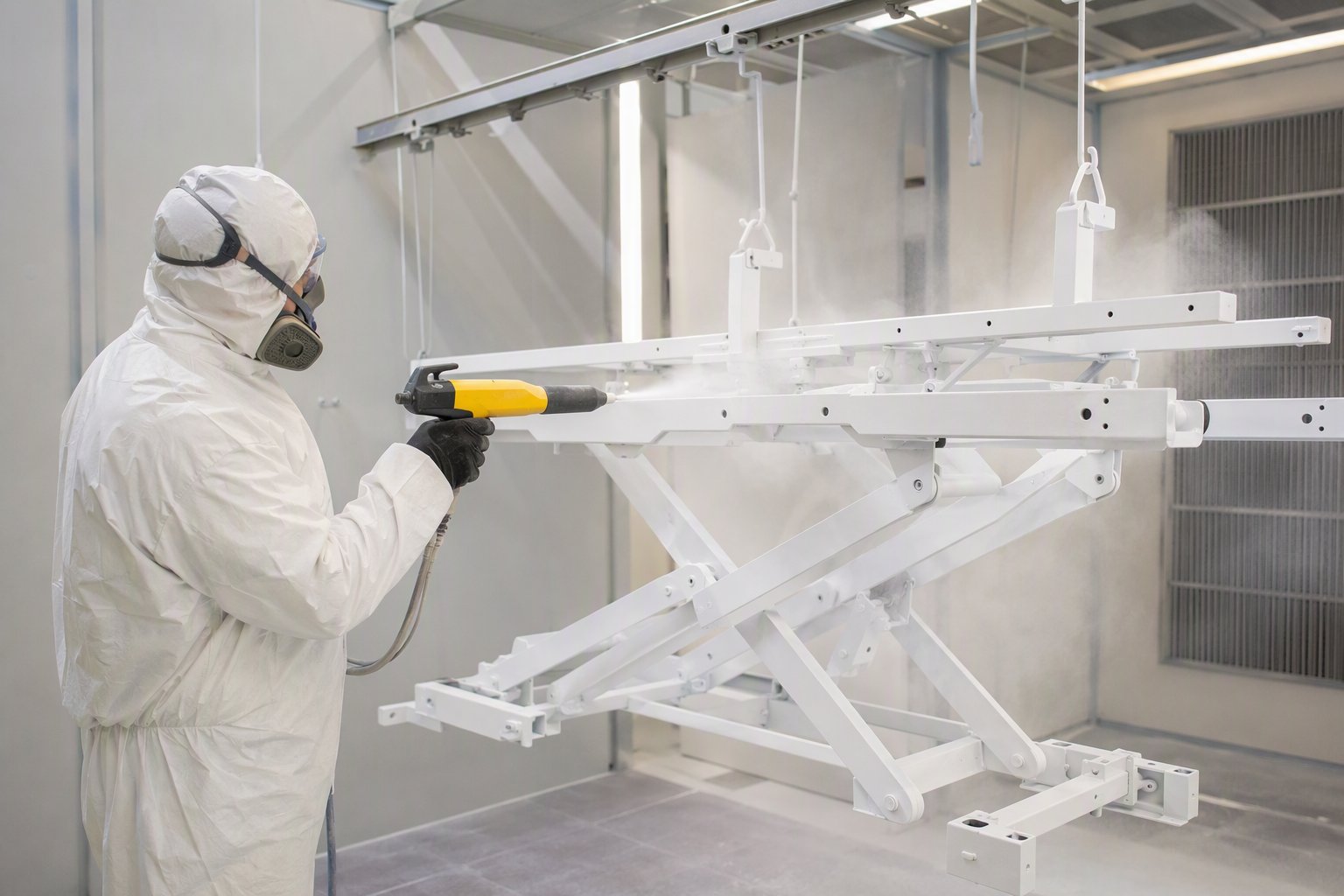
How a Linear Actuator Works
The core driving component is the Linear Actuator.
– Motor rotates a worm.
– Worm drives a worm gear for speed reduction.
– Worm gear rotates a lead screw.
– Lead screw moves a nut linearly.
– The nut pushes the inner tube for lifting.
Jiechang vs. Linak: Two Philosophies of Transmission
Hongdee offers two motor configurations:
| Dimension | Jiechang (China) | Linak (Denmark) |
|:—|:—|:—|
| Positioning | China’s medical drive leader | Global medical transmission benchmark |
| Thrust | 2000N–6000N | 2000N–6000N |
| Noise | 48dB (Mid-load) | 45dB (Full-load range) |
| Lead Screw Precision | C5–C7 Grade | C3–C5 Grade |
| Worm Gear Material | Alloy Steel + Copper | Special Alloy + Self-lubricating |
| Cost Difference | Baseline | Approx. 2–3 times |
Engineering Detail: Linak actuators use helical worm gears—providing more contact surface area, less stress per tooth, lower noise, and longer life. Standard straight-cut gears have “line contact,” while helical gears have “surface contact,” reducing contact stress by about 60%.
Additionally, Linak actuators feature built-in PTC self-resetting thermal protection. Budget actuators use one-time thermal fuses; once overheated, they are permanently broken. This is the difference between “working” and “working for a decade.”
Transmission Belts: Why Jack Pro is Worth It
| Transmission | Jack Pro | Budget Competitors |
|:—|:—|:—|
| Method | Stainless steel rails + ball bearings | Plastic rollers sliding between tubes |
| Belt Brand | Gates (USA) Industrial Grade (~$10) | Domestic Generic (~$1) |
| Belt Material | USA Made, Kevlar reinforced | Domestic, Pure Rubber |
| Pulley Material | Cast Aluminum Alloy | Cast Iron (Heavy + Rust-prone) |
Clinical Link: Ball bearings on rails have extremely low friction, providing a smooth lift without “stepping.” Plastic rollers have high and uneven friction, causing a “jerking” sensation. This vibration is transmitted to the tabletop, appearing as “table shaking” while measuring intraocular pressure.
A $10 Gates belt, reinforced with Kevlar (the material in bulletproof vests), has minimal stretch. Budget rubber belts stretch over time, causing the table to fail to reach its target height.
—
Chapter 7: Casters — The Forgotten Precision Component
Metal Casters vs. Medical-Grade Plastic Casters
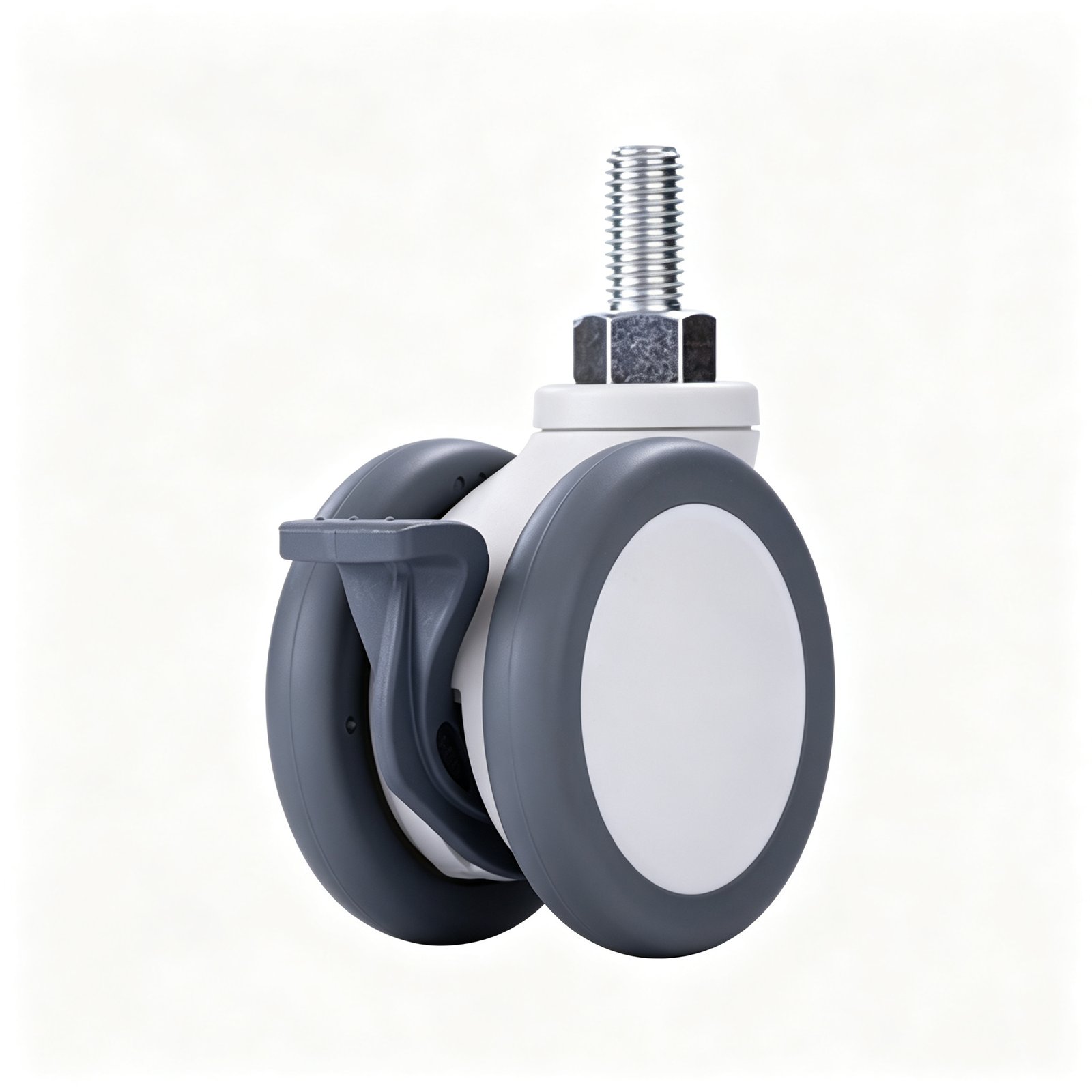
| Dimension | Metal Casters (Standard) | Medical-Grade Plastic (65mm) |
|:—|:—|:—|
| Diameter | 40mm | 65mm |
| Surface Material | Polyurethane over Metal | Medical-grade PU |
| Bearings | Sleeve Bearings (Bushings) | Dual Sealed Deep Groove Ball Bearings |
| Noise | Metallic rolling sound | Near silent |
| Floor Suitability | Tile, Cement | Carpet, Wood, Epoxy |
| Anti-wrap | General | Sealed to prevent hair/debris entanglement |
Factory Detail: The “cost” of medical-grade casters lies in the bearings. Dual-sealed ball bearings have 7–9 ground steel balls with a friction coefficient of 0.001, compared to 0.1 for bushings—a 100-fold difference. This determines whether a table moves smoothly or feels like it’s “running through sand.”
To Brake or Not to Brake
At least two of the four casters must have locking functions. Quality locks simultaneously lock both rotation and swivel, ensuring the table remains rock-solid during slit lamp operations.
Factory Detail: Locking pedal material and heat treatment determine how many times you can lock it. Standard iron pedals can fatigue and snap. Hongdee uses 3mm stamped steel with local quenching, tested for over 20,000 cycles.
—
Chapter 8: Tabletop — The Most Visible “Facade”
Tabletop Substrates: MDF vs. Tempered Glass vs. Plywood
| Substrate | Pros | Cons | Usage |
|:—|:—|:—|:—|
| High-Density MDF | Extremely flat, zero warp | Moisture sensitive | Standard |
| Tempered Glass | Ultimate flatness, easy clean | Heavy, Brittle | Optional Upgrade |
| Plywood | Great texture, strong grip | High cost, Thicker | Premium OEM |
Factory Detail: MDF’s weakness is water absorption. If the edge banding fails, moisture from clinic cleaning will cause it to swell. Hongdee uses ABS (Acrylonitrile Butadiene Styrene) edge banding—not PVC. ABS has far better heat and impact resistance. 120°C hot-melt adhesive fuses the banding to the tabletop, preventing moisture ingress.
The tabletop surface is covered with an Anti-UV laminate, similar to the logic of the UV coating on the columns. It withstands the constant friction of slit lamp handles and instrument bases.
—
Chapter 9: Assembly — Bringing Parts to Life
Assembly Line Layout
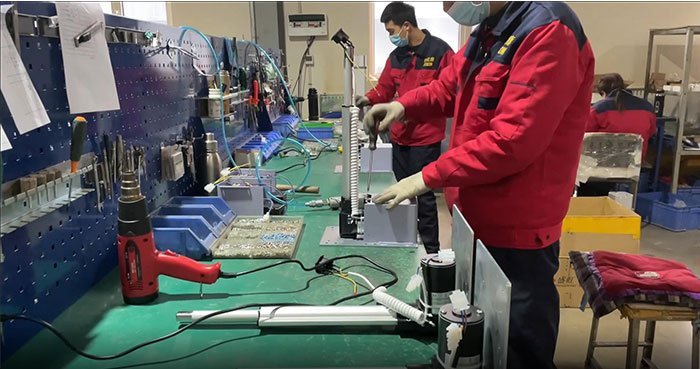
Hongdee operates four assembly lines following a single-direction flow:
`Parts Area → Pre-assembly → Main Assembly → Electrical → Calibration → Inspection → Packaging`
Factory Detail: Each station has an assembly process card—a laminated A4 sheet with exploded diagrams, critical bolt torque values, and precautions. This ensures consistency and complies with ISO 13485 audit requirements.
Critical “Manual Feeling” Processes
While machines provide precision, humans provide judgment. Several steps rely on a technician’s experience:
1. Actuator Concentricity Calibration: The actuator axis must align perfectly with the column axis. A 1–2mm deviation causes noise and premature wear. Workers run the lift 3–5 times, feeling the vibration with their palms to detect deviations of even 0.01mm.
2. Caster Locking Force Check: Manually engaging each lock to ensure uniform force—not too tight for a nurse to kick, nor too loose to be ineffective.
3. Cable Routing and Anti-pinch Test: Ensuring cables are secured so they aren’t pinched during lifting.
—
Chapter 10: Final Inspection — The Last Guard
Load Testing
The finished table is loaded with 1.2x its rated capacity (e.g., 60kg for a 50kg rating) and run through complete cycles:
– Unloaded Noise: Should be below 48–55dB.
– Full Load Noise: Should not increase by more than 5dB.
– Full Load Speed: Should not drop by more than 15%.
– Full Load Tilt: Height difference across the four corners <2mm.
Factory Detail: Noise testing is conducted in a soundproof room lined with acoustic foam. A decibel meter is placed 1 meter from the table at a height of 1.5 meters (simulating a doctor’s ear).
Stability Testing
With the table at maximum height and fully loaded, a 25kg horizontal force is applied from four directions (simulating a patient leaning on the table):
– No significant wobbling.
– No caster slippage.
– Base remains on the floor.
Electrical Safety Testing
– Insulation Resistance: ≥10MΩ.
– Withstand Voltage: 1500V AC for 1 minute without breakdown.
– Grounding Resistance: ≤0.1Ω.
– Leakage Current: ≤0.5mA.
Only after passing these can CE and FDA marks be applied.
—
Chapter 11: Packaging — The Underrated Final Step
A table that passes all inspections is useless if damaged in transit.
– Inner Layer: Custom-cut EPE pearl cotton wrapping every corner.
– Middle Layer: Corrugated cardboard pads to absorb axial shocks.
– Outer Layer: Five-layer corrugated box (K=K standard, compression strength ≥500kg/m²).
Factory Detail: The pearl cotton must be “snug but not hard.” If too tight, it might scratch the UV coating during unboxing; if too loose, the table will shift. The ideal density is 25kg/m³.
—
Epilogue: Why You Need to Know This
If you are a clinic owner: Understanding these details ensures you won’t be misled by “we can do it too” low-price factories. You know that the real value lies in whether the inner column was coated—something you can’t see from the outside, but which prevents rust from appearing on your floors in two years.
If you are a Purchasing Manager/Distributor: When customers ask why your table is more expensive, this is your answer. The extra $50 is spent on laser precision, full welding labor, UV coating, and Linak actuators. Every cent is accounted for.
If you are a Doctor: The next time you press that lift button and hear a quiet “hum” rather than a clatter, you’ll know it’s the result of 30 workers, 12 processes, and hundreds of quality checkpoints.
A good table doesn’t speak. But in ten years, you won’t want to replace it—that is its best language.
—
Hongdee Corporation — 18 years of manufacturing ophthalmic instrument tables since 2008. ISO 13485 certified. FDA Listed. CE Approved. Partner to world-leading brands.
[Explore our full range of lifting tables →](/products) | [Consult on OEM customization →](/oem) | [Download the latest product catalog →](/catalog)